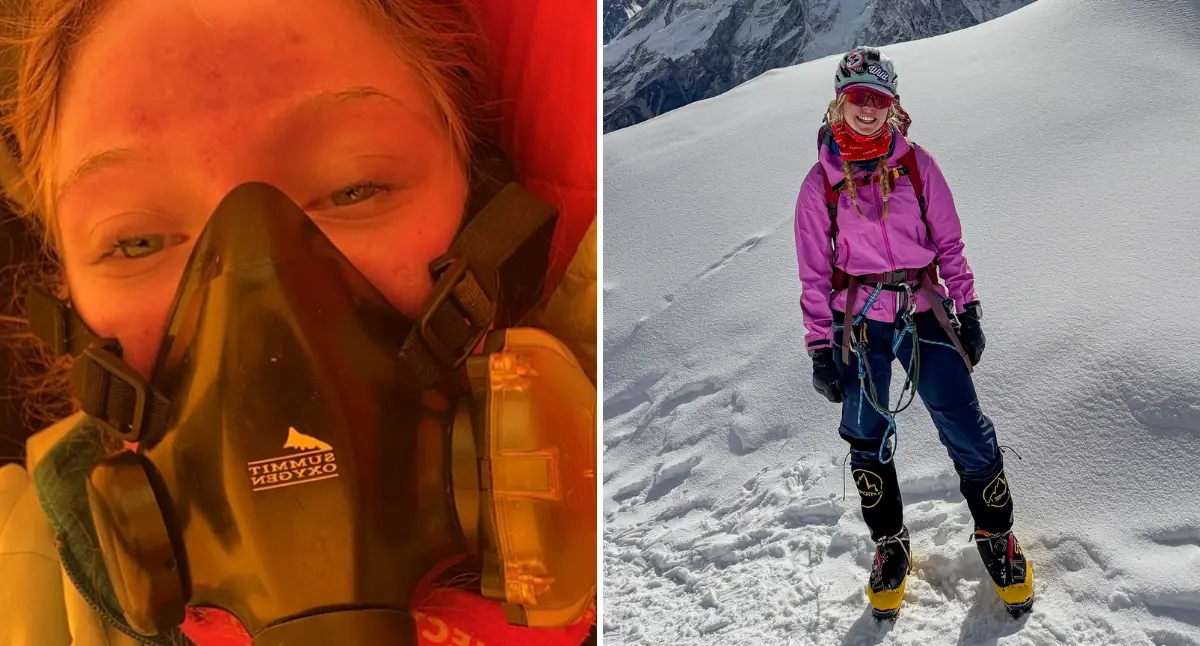
She turned back 400 metres from the top last year. On Wednesday, she made it all the way.
Bianca Adler left for Nepal at the beginning of April with unfinished business. On Wednesday morning, just before 2.20am local time, she finished it.
The 18-year-old Melbourne student reached the 8,849-metre summit of Mount Everest accompanied by her guides Pemba and Ngdu, becoming the youngest Australian to stand at the top of the world’s tallest mountain.
Calling her father from the summit, Adler said she felt “really good” though she was quick to note the journey was only half done.
“Really good, but the weather is really bad,” she said on the call.
She has since descended to camp two and is continuing her way down the mountain, with both parents watching closely.
“On the summit and climbing up, I felt amazing, but coming down is tough,” she wrote in a blog post published by her mother Fiona. “I’m just trying to take it one step at a time. It’s so beautiful.”
What last year’s attempt cost her and what it taught her
Adler’s first attempt at Everest in May 2025 ended 400 metres from the summit. Strong winds, creeping frostbite and illness forced her to make the call to turn back a decision that almost certainly saved her life, and one she has spoken about with maturity beyond her years.
This year’s attempt, which began in early April, takes between six and nine weeks to complete from departure to return.
Her father accompanied her for the majority of the trek. Her mother Fiona, who along with Adler’s father has previously summitted Everest herself, chose a different approach helicoptering directly into base camp rather than completing the eight-day trek, having prepared for the altitude risk by sleeping in a simulated altitude tent at the family’s Brighton home in Melbourne.
A record-breaker before she finished high school
Wednesday’s summit is not Adler’s first entry in the record books. In 2024, at just 16 years old, she broke the Guinness World Record to become the youngest woman to climb Nepal’s Manaslu the eighth-highest mountain in the world.
She grew up climbing in the French Alps and has summitted multiple major peaks, developing the technical experience and altitude acclimatisation that underpins what she achieved on Wednesday.
Despite her mountaineering resume, Adler is still a Brighton secondary school student completing her VCE. Asked what comes next, her answer was grounding.
“My next adventure will now be finishing high school,” she said.
The mountain she climbed and its complications
Everest is no longer simply the world’s greatest mountaineering challenge. It has become a subject of sustained controversy over overcrowding, safety, commercialisation and environmental damage.
The number of climbers attempting the summit has grown dramatically in recent decades, creating dangerous human traffic jams in the so-called death zone above 8,000 metres conditions that put both paying climbers and their Nepalese guides at serious risk. The mountain is estimated to hold approximately 50 tonnes of waste, and hundreds of bodies remain on its slopes.
For years, the economics of Everest expeditions which typically cost between $40,000 and well over $100,000, including government climbing permits exceeding $10,000 heavily favoured Western guiding companies while Sherpa guides, who performed the most dangerous and physically demanding work, were paid comparatively little.
In recent years that balance has begun to shift, with control over climbing operations increasingly transferred to Nepali guides and local companies, who are now compensated more fairly and granted greater recognition for their central role in every successful summit.
For Adler and her guides Pemba and Ngdu, the summit on Wednesday morning was a shared achievement one step at a time, in bad weather, at the top of the world.
Bianca Adler continues her descent and is expected to return to base camp in the coming days.