A Bondi removalist did nothing wrong. She built her business on good reviews, good service and word of mouth. Then strangers started destroying it on purpose and wanted her to pay them to stop.
Gina Petrovski had never heard of the scam before it happened to her.
In the space of 48 hours, four one-star reviews appeared on the Google profile of her Bondi-based removalist business, Move It With Gina. The reviewers had generic names she didn’t recognise none of them were on her client list. The reviews were vague, damning and completely fabricated.
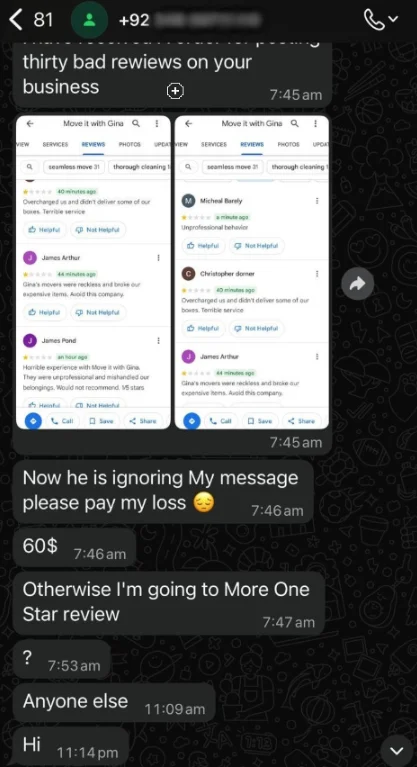
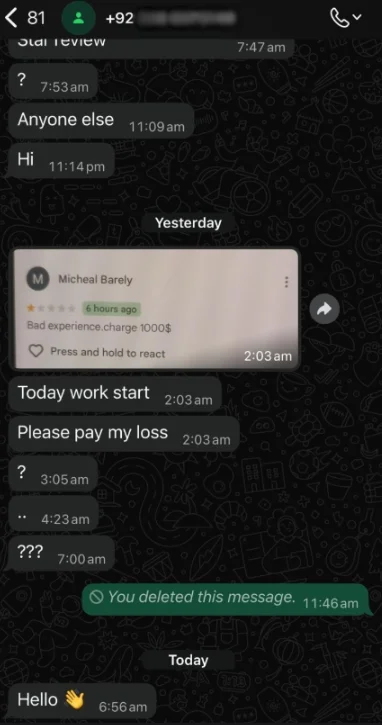
“Bad experience. Charge $1000,” one said. Another claimed staff were “reckless and broke our expensive items” and told others to “avoid this company.”
“Google reviews for us are so important,” Petrovski told ABC News. “Even a single poor review can really hurt the business.”
Then came the message.A WhatsApp number with a Pakistani country code contacted Petrovski with a blunt demand: pay $60, and the reviews would be deleted. The sender admitted openly that the reviews were fake, explaining they had been hired to leave 30 bad reviews but had not been paid by their client and were now passing the bill on to her instead.
“$60 otherwise I’m going to More One Star review,” the message read, alongside screenshots of the damage already done.
Petrovski did not pay. A day later, the scammer messaged again: “Today work start … Please pay my loss.”
She reported the reviews four separate times before Google eventually removed them. But in the days it took to resolve the matter, the fake reviews sat publicly on her profile visible to every potential customer who searched for her business.
“It’s not right the way Google controls it and doesn’t really care,” she said, “but yet everybody relies on the Google reviews.”
This is not an isolated incident it is a coordinated international crime pattern
Petrovski’s experience, while distressing, follows a textbook pattern that has emerged across Australia and internationally throughout 2025.
Research has identified what analysts describe as “the first truly global review extortion epidemic,” with evidence of operations spanning from California to Switzerland to Australia, using the same fraudulent accounts posting negative reviews for completely unrelated businesses across multiple countries on the same day.
In late 2025, a wave of review extortion scams hit Australian businesses directly. In one case reported by a Melbourne digital agency, a contractor lost three contracts worth $45,000 after fake one-star reviews dropped their rating from 5.0 to 3.6 stars overnight.
The scale globally is significant. Businesses lose approximately $152 billion each year due to fake reviews, with coordinated attacks documented targeting construction companies, locksmiths, rental companies and home services operators particularly those that rely on local search visibility for new customers.
The pattern is consistent enough that cybersecurity firms and digital marketing professionals can now identify it immediately. It typically starts with a burst of 15 or more one-star reviews within a 24-hour window, from profiles with no photos, generic names or similar grammar.
Shortly after, the business owner is contacted by someone often an overseas WhatsApp number or throwaway social media account making an explicit demand: pay up, or more reviews will follow.
Why Google’s systems struggle to stop it
Petrovski’s frustration with Google’s response process reflects a structural weakness that scammers have learned to exploit.
Because scammers write full paragraphs and mimic the tone of real customers, Google’s automated AI systems may not flag the reviews as fraudulent immediately leaving the burden of proof entirely on the business owner. In the time it takes Google to investigate, the fake reviews remain publicly visible, weighing down a business’s star rating and potentially redirecting customers to competitors.
Google removed over 240 million policy-violating reviews in 2024 up from 170 million the year before. The sheer volume suggests the platform is under sustained pressure from coordinated abuse at a scale its automated systems are struggling to match.
Petrovski said Google’s tools gave her little to work with while she waited. She suggested that allowing business owners to attach images such as a screenshot of a scammer’s extortion message directly to their public reply to a review would at least give other consumers context while an investigation was underway.
What Australian authorities say
The ACCC’s Scamwatch has integrated fake review extortion reporting into its scam database, and the National Anti-Scam Centre has flagged extortion-based scams as a growing concern for small businesses.
In 2025, Australians made a combined total of 481,523 scam reports across government reporting institutions, with financial losses totalling $2.18 billion an increase of 7.8 per cent on 2024. While review extortion sits within a broader category of false billing and extortion scams, authorities say underreporting remains a major challenge, with many small business owners too embarrassed or time-poor to formally report the incidents.
Extortion is a criminal offence under Australian law. Business owners who receive demands of this kind are advised to report to WA Police or their state police service, as well as to the ACCC’s Scamwatch at scamwatch.gov.au.
What to do if it happens to your business
Google introduced a dedicated Merchant Extortion Report Form in late 2025, which routes cases directly to its Trust and Safety team. Local SEO professionals report that submissions through this form result in fake reviews being removed within days rather than the weeks that standard reporting can take.
Experts advise business owners to:
Screenshot every fake review immediately, including reviewer names and timestamps. Save all extortion messages with dates and sender details. Report through Google’s Merchant Extortion Form rather than flagging reviews individually. Report to Scamwatch at scamwatch.gov.au and to your state police. Do not pay. Paying confirms you are a viable target and typically results in further demands.
Experts also strongly advise against buying positive reviews to dilute the fakes Google’s systems can detect review pattern manipulation, and businesses caught doing so have been blocked from receiving any new reviews at all for up to eight months.
For Petrovski, the experience has left her more alert but also more determined. She has begun asking genuine clients to leave reviews, knowing that a strong baseline of authentic feedback is the most durable protection against future attacks.
“I think it’s good feedback, I think consumers should be communicating with the business,” she said of genuine reviews. The fake kind, she is less philosophical about.
“I’m not surprised,” she said of how easy the scam is to run. “It’s very easy to do.”
Business owners who receive extortion demands linked to fake Google reviews can report to Scamwatch at scamwatch.gov.au or call 1300 795 995. Google’s Merchant Extortion Form is accessible through the Google Business Profile Help Centre.